


Running an online community requires much more than publishing content and starting discussions. As the number of members grows, community owners often face an increasing amount of repetitive administrative work.
New members need help navigating the platform. Existing members ask where specific lessons, recordings, templates, or resources are located. The same questions appear repeatedly, while posts need to be organized, discussions moderated, and members directed toward relevant content.
Over time, these small tasks can consume a significant part of the working day and leave less time for creating new content, improving the community experience, and communicating with members directly.
Circle AI is designed to reduce this operational workload by integrating artificial intelligence directly into the Circle community platform.
The platform combines AI Agents, the Knowledge Engine, AI Inbox, and AI Workflows to help community owners answer recurring questions, improve content discovery, organize member interactions, and automate repetitive community management tasks.
What Is Circle AI?
Circle AI is a collection of AI-powered tools integrated directly into the Circle platform.
Unlike a general-purpose AI chatbot, Circle AI operates within the environment where your community already interacts, accesses courses, reads posts, attends events, and uses educational resources.
The main advantage of this approach is context.
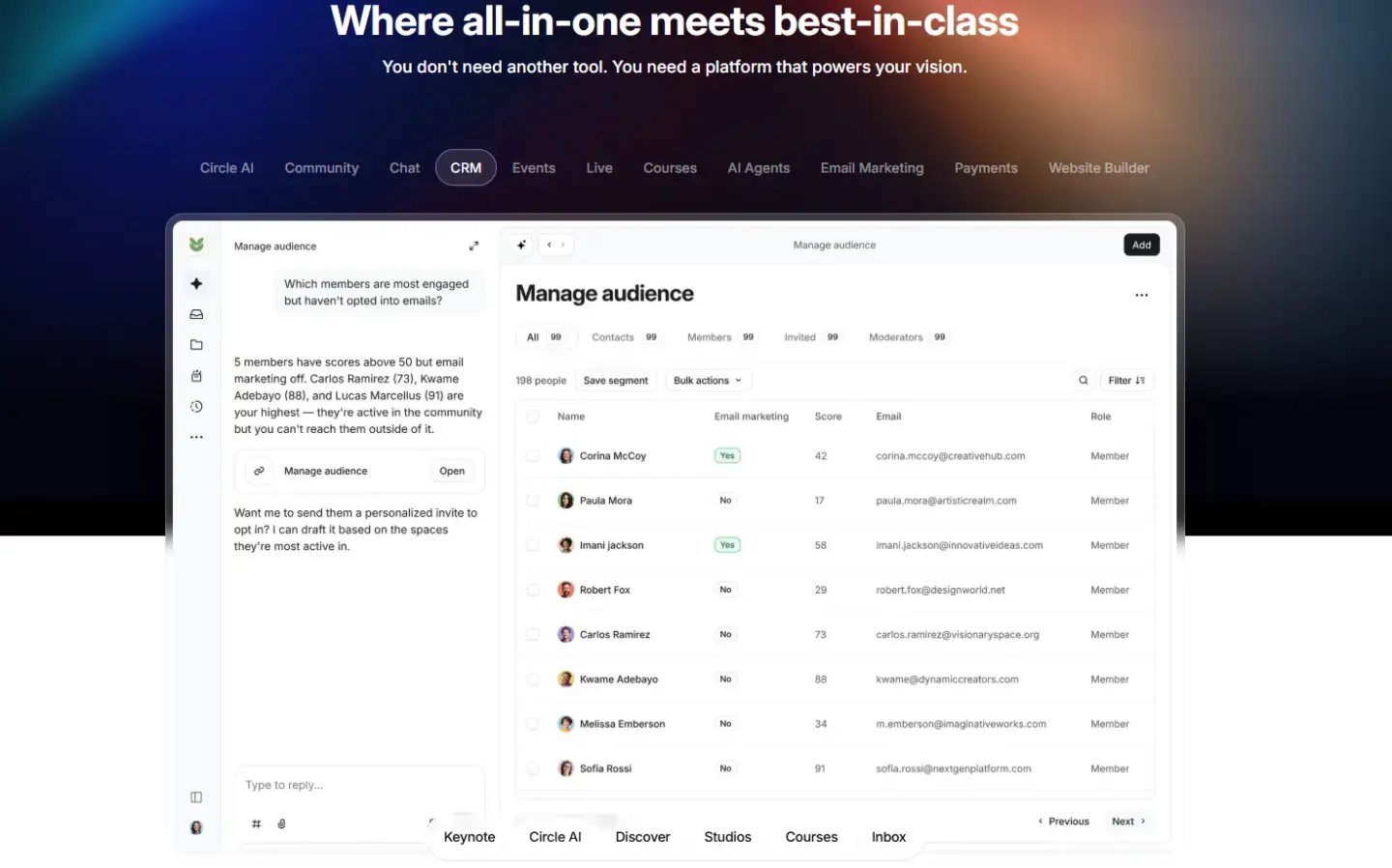
A generic chatbot does not automatically understand your courses, community structure, internal resources, or the information available to members. Circle allows community owners to give AI access to selected knowledge so that it can provide answers based on the content already available inside the community.
The Circle AI ecosystem currently includes:
AI Agents
Knowledge Engine
AI Inbox
AI Workflows
Together, these tools help automate common support and community management processes while allowing creators to remain involved in interactions where personal communication is important.
What Are Circle AI Agents?
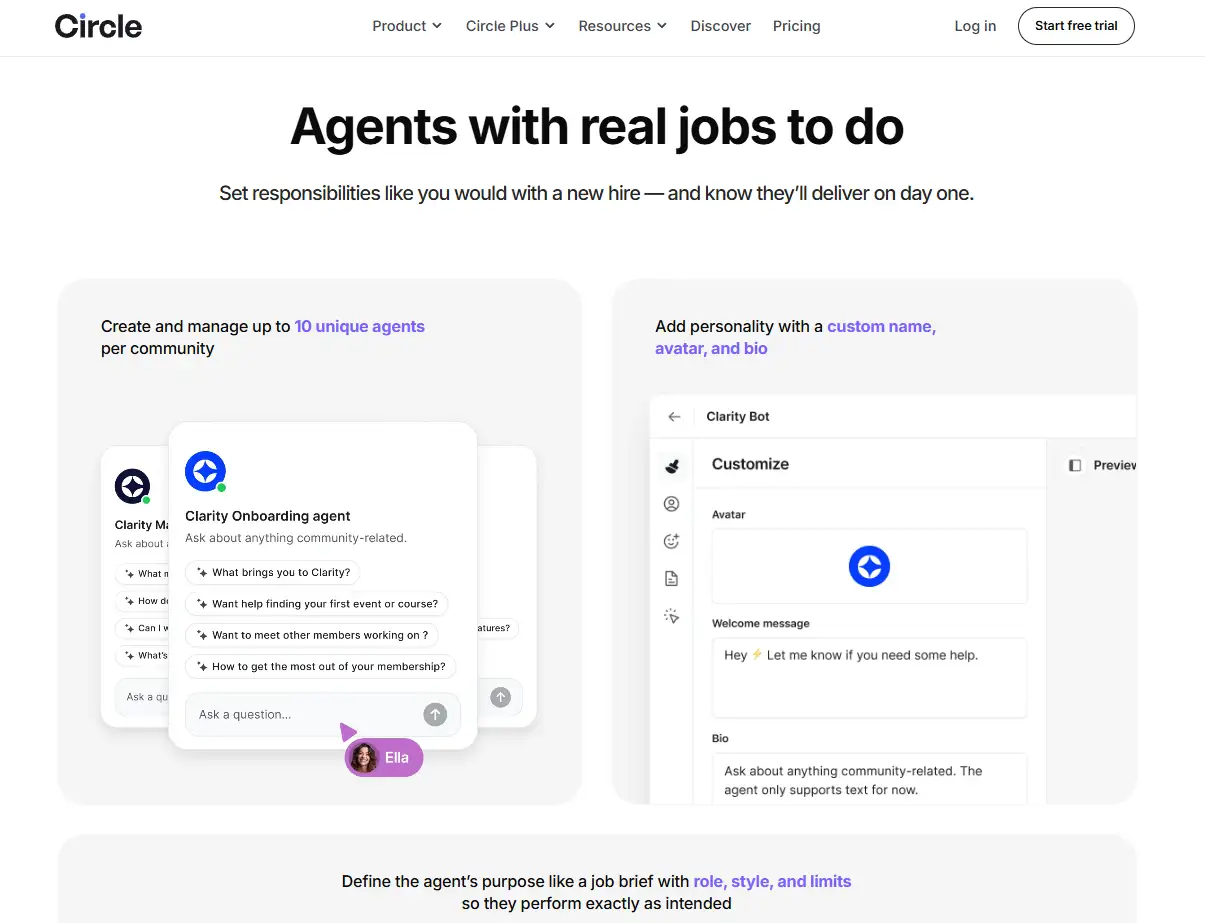
AI Agents are assistants that can be created for specific roles within a Circle community.
Instead of using one general chatbot for every task, community owners can configure different agents for different purposes.
For example, one AI Agent can help new members understand how the community works, while another can assist students with finding lessons, recordings, or educational materials.
Common use cases include:
onboarding new members;
answering frequently asked questions;
helping students navigate course materials;
directing members toward relevant resources.
This approach becomes especially useful when a community contains a large amount of content.
A course creator may have dozens of lessons, guides, templates, recordings, and discussions accumulated over several months or years. Even when this information remains useful, finding a particular resource can become difficult for members.
Without AI, a member may need to manually search through different spaces or contact the community owner directly.
With an AI Agent connected to the appropriate knowledge, the member can ask a question and receive guidance toward the relevant information more quickly.
AI Agents and Human Community Management
The purpose of AI Agents is not to remove personal communication from the community.
For many paid communities, courses, coaching programs, and membership businesses, direct interaction with the creator or other members remains one of the main reasons people join.
AI is more useful for handling repetitive operational questions that do not necessarily require personal attention.
For example, a creator does not need to personally answer the same question about the location of a recording every time a new member asks it.
By automating these requests, community owners can spend more time on activities where their direct involvement provides greater value, such as creating educational content, providing feedback, participating in discussions, and improving the overall member experience.
How the Circle Knowledge Engine Works
An AI assistant can only provide useful answers when it has access to relevant information.
Circle's Knowledge Engine provides AI Agents with the context they need to respond to member questions.
Community owners can connect relevant information from their Circle environment and other available resources.
For a course creator, this knowledge may include:
course lessons;
educational materials;
guides;
templates;
frequently asked questions.
For a professional community, the knowledge base may also include community posts, internal resources, discussions, and other useful information.
This can be particularly valuable for established communities with large content libraries.
As more content is published, older materials gradually become more difficult to discover. A useful guide created several months ago may still answer a member's question, but the member may never find it through manual navigation.
The Knowledge Engine makes this existing content easier to access through AI-powered conversations.
Instead of searching through multiple spaces and old posts, members can ask what they need and potentially be directed toward the appropriate resource.
How Circle AI Workflows Reduce Repetitive Tasks
Circle AI is not limited to answering questions.
AI Workflows are designed to automate community management tasks that would otherwise require manual work.
Traditional automation usually operates through fixed rules. A specific event occurs, and the system performs a predefined action.
AI-based automation can be more flexible because it can evaluate the context of a post or interaction before determining the appropriate response or action.
Circle AI Workflows can potentially support tasks such as:
organizing and categorizing posts;
welcoming new members;
responding to recurring questions;
supporting moderation;
identifying content that may require attention;
directing members toward relevant discussions or resources.
This functionality becomes increasingly useful as community activity grows.
A single administrative task may only require one or two minutes. However, when dozens or hundreds of similar interactions occur repeatedly, the total workload can become significant.
Automating part of this process can reduce pressure on the community owner while helping members receive faster and more organized support.
Circle AI for Course Creators
Course creators often manage large libraries of lessons, recordings, templates, guides, and supplementary materials.
As the number of students grows, many of the same questions begin to appear repeatedly.
Students may ask where a specific recording is located, which lesson they should complete next, or where they can find a particular resource.
Circle AI can help reduce this repetitive support workload by allowing students to search for information through conversation.
AI Agents can direct students toward relevant course materials, while the Knowledge Engine gives those agents access to the information required to provide useful answers.
This allows course creators to spend more time improving educational content instead of repeatedly answering navigation questions.
Circle AI for Membership Communities
Membership communities often accumulate a large amount of information over time.
New members may struggle to understand where important resources are located or which discussions are most relevant to them.
AI Agents can help members navigate these resources and answer common onboarding questions.
AI Workflows can also support organization and recurring administrative processes as the membership grows.
This can make a large content library easier to use without requiring the community owner to manually guide every member.
Circle AI for Coaches and Consultants
Coaches and consultants frequently provide support between scheduled calls or sessions.
Some questions require professional judgment and direct involvement, while others relate to existing materials, resources, or processes.
Circle AI can help handle repetitive questions and direct clients toward information that has already been provided.
This allows coaches and consultants to reserve more of their time for conversations where their personal expertise is necessary.
Circle AI for Professional Communities
Professional communities often involve a combination of networking, educational content, discussions, events, and internal resources.
As these communities grow, onboarding, moderation, content organization, and information discovery can become increasingly difficult to manage manually.
Circle AI can help support these processes through AI Agents and automated workflows.
The goal is not to automate every interaction, but to reduce repetitive work while keeping the community organized and accessible.
Circle AI Features Overview
Feature |
Main Purpose |
AI Agents |
Answer questions and guide members toward relevant information |
Knowledge Engine |
Gives AI access to selected community knowledge and resources |
AI Inbox |
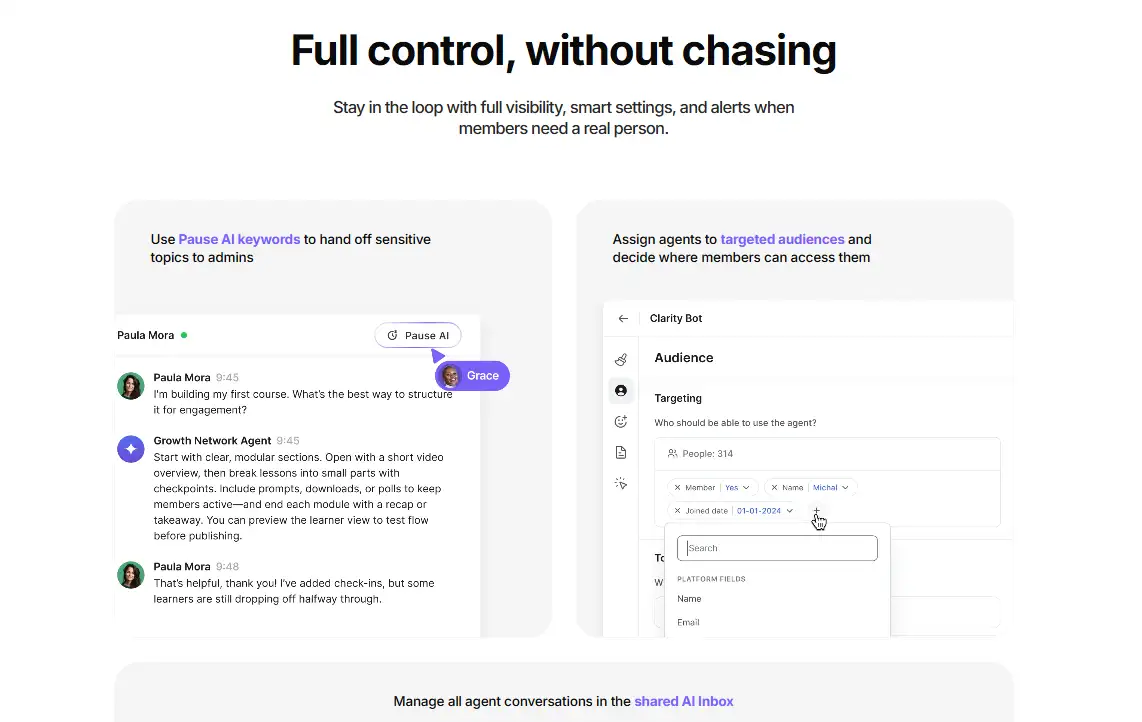
Helps community owners monitor and manage AI conversations |
AI Workflows |
Automates repetitive community management tasks |
In short: AI Agents handle conversations, the Knowledge Engine provides context, AI Inbox helps manage AI interactions, and AI Workflows automate repetitive processes.
Who Is Circle AI Best For?
Circle AI generally becomes more useful as the size and activity level of a community increases.
A small community where every member receives direct personal attention may not require extensive automation.
The situation changes when the number of questions, posts, resources, and member interactions begins to grow.
Circle AI may be particularly useful for:
course creators managing large content libraries;
paid membership communities;
coaches and consultants;
professional communities;
creators receiving recurring support questions.
The more frequently the same operational tasks appear, the greater the potential value of automating part of the process.
What Makes Circle's Approach to AI Different?
The main advantage of Circle's approach is that AI operates inside the same platform where the community already exists.
Community owners do not necessarily need to create a separate AI system and then connect it to their courses, resources, discussions, and member database.
Circle already provides the environment where members consume content, communicate, participate in events, and access community resources.
Integrating AI directly into this environment allows the technology to operate closer to the actual member experience.
Instead of using AI primarily for external content generation, such as creating another social media post or email, Circle focuses on using AI for the operational side of running a digital community.
When Does Circle AI Provide the Most Value?
Circle AI becomes particularly useful when repetitive community management starts consuming a noticeable amount of time.
Typical signs include:
members repeatedly ask the same questions;
important resources are becoming difficult to find;
onboarding requires frequent manual assistance;
the community contains a large amount of older content;
moderation and organization require increasing attention;
creators spend too much time directing members toward existing information.
In these situations, AI can help reduce administrative workload without removing the human interactions that make the community valuable.
Is Circle AI Worth Trying?
Circle AI may be worth considering if your community is growing and support, organization, and recurring questions are beginning to require more of your time.
Its main value is not simply the presence of artificial intelligence.
The more important advantage is the ability to use AI directly inside the existing community environment.
AI Agents can help answer routine questions. The Knowledge Engine gives those agents access to relevant information. AI Workflows can automate repetitive management processes.
At the same time, creators can continue handling the conversations, feedback, and relationships where direct human involvement matters most.
Final Thoughts
Circle AI represents a practical approach to integrating artificial intelligence into online community management.
Instead of treating AI as a separate tool, Circle places it directly inside the day-to-day operation of a community.
AI Agents can help members find answers and relevant resources. The Knowledge Engine provides the context required for those answers. AI Inbox helps community owners manage AI interactions, while AI Workflows can automate repetitive tasks.
For creators running courses, paid memberships, coaching programs, or professional communities, these tools can become increasingly useful as the number of members and interactions grows.
The purpose of Circle AI is not to replace the community manager.
It is to reduce repetitive operational work so that creators can spend more time on the parts of community building where human expertise, communication, and relationships provide the greatest value.
FAQ
Circle AI helps community owners automate repetitive tasks, answer common member questions, improve content discovery, support onboarding, and organize community interactions using tools such as AI Agents, the Knowledge Engine, AI Inbox, and AI Workflows.
Yes. Circle's Knowledge Engine can provide AI Agents with access to selected community knowledge and resources, allowing them to answer questions based on the information available inside your community.
No. Circle AI is better suited to repetitive operational tasks such as answering FAQs, helping members find resources, and supporting moderation. Human involvement is still important for relationships, feedback, expertise, and community building.
Circle AI is best suited for growing communities, course creators, membership businesses, coaches, consultants, and professional communities that deal with recurring questions, large content libraries, onboarding tasks, and increasing administrative workload.