

AI agents in email marketing represent a shift from purely manual processes and rigid rule-based automations toward more proactive, context-aware systems that can help prepare campaigns, analyze performance, monitor marketing activity, and surface useful next steps. For marketers, founders, small businesses, ecommerce brands, SaaS companies, course creators, agencies, and B2B teams managing increasingly complex customer journeys, these capabilities can reduce repetitive preparation and analysis while keeping human strategy, judgment, and approval central.
Traditional email tools often stop at broadcasting newsletters or executing predefined triggers. Modern AI-assisted platforms can go further by using account history, campaign performance, brand context, audience engagement, and relevant external signals to provide more useful assistance. ActiveCampaign combines email marketing, automation, customer journeys, CRM capabilities, and integrations with Active Intelligence 3.0: Wavelength—its proactive, account-aware AI layer—to offer a practical example of this evolution.
Quick Answer
AI agents in email marketing are AI-powered systems that can assist with campaign planning, content creation, account analysis, monitoring, research, recurring tasks, and optimization. Unlike traditional automation that primarily follows fixed “if-this-then-that” rules configured in advance, newer AI systems can use broader account context to surface recommendations, prepare drafts, identify areas that need attention, and in some cases carry out approved actions.
ActiveCampaign with Active Intelligence is particularly relevant for teams that want AI assistance integrated directly with their marketing automation environment. Active Intelligence 3.0: Wavelength can draw on account history, automations, performance patterns, audience behavior, brand context, and external signals to provide more proactive and account-specific support.
Comparison Table: Basic Tools vs Traditional Automation vs AI-Powered Platforms
| Aspect | Basic Email Tools | Traditional Automation Platforms | AI-Powered Platforms (e.g., ActiveCampaign) |
|---|---|---|---|
| Campaign Planning | Manual drafting | Templates and predefined workflows | Proactive drafts and campaign ideas grounded in account context |
| Segmentation | Basic lists | Rules, tags, and behavioral conditions | AI-assisted audience insights informed by account and engagement data |
| Personalization | Limited merge tags | Conditional content | AI assistance informed by brand context, account history, and content performance |
| Automation Depth | Simple sequences | Complex if/then workflows | Proactive assistance, scheduled AI tasks, monitoring, and account-aware actions |
| Send-Time Optimization | None or manual | Scheduling and configured timing rules | AI-assisted timing, scheduling, and recurring campaign tasks |
| Content Creation | Write everything manually | Templates and reusable content | AI-generated drafts, images, translations, and ideas informed by brand context |
| Customer Journey Management | Basic flows | Visual builders and predefined automation logic | AI-assisted monitoring, insights, drafts, and recommended next steps |
| CRM/Customer Data | Minimal | Some integration | CRM and marketing data combined with shared account context for AI assistance |
| Reporting | Basic opens/clicks | Standard metrics and dashboards | Content performance analysis, benchmarks, monitoring, and AI-assisted recaps |
| Manual Work Required | High | Medium | Lower for preparation and monitoring, with human review and approval |
| Best Fit | Very small lists, broadcasts | Teams with established rule-based workflows | Growing teams that benefit from proactive, account-aware marketing intelligence |
What Are AI Agents in Email Marketing?
AI agents in this context are AI-powered systems or capabilities designed to perform or assist with specific marketing tasks using campaign data, account context, instructions, and AI models. They do not need to run the entire marketing operation autonomously. Instead, they can assist by:
-
Preparing campaign drafts and ideas from goals, account history, and marketing context
-
Surfacing audience, engagement, and performance insights from available account data
-
Generating or refining email content while using brand context and past performance as guidance
-
Scheduling recurring AI tasks and surfacing recommended next steps when marketing activity needs attention
-
Analyzing content and automation performance, monitoring relevant signals, and highlighting opportunities for review
ActiveCampaign’s Active Intelligence brings several of these capabilities together through Active Intelligence 3.0: Wavelength, using a shared context layer that can incorporate account history, automations, campaign performance, audience behavior, brand information, and relevant external signals.
How AI Agents Differ from Traditional Email Automation
Traditional automation primarily relies on rules you define in advance: “If someone subscribes, send email 1 after 1 day, then take another action when a specified condition is met.” This approach remains useful for predictable customer journeys, but marketers are responsible for configuring the logic, monitoring performance, and deciding when workflows need to change. AI-agent-style capabilities add another layer by interpreting broader account context, preparing work proactively, monitoring activity, and surfacing recommendations before every next step has to be manually requested.
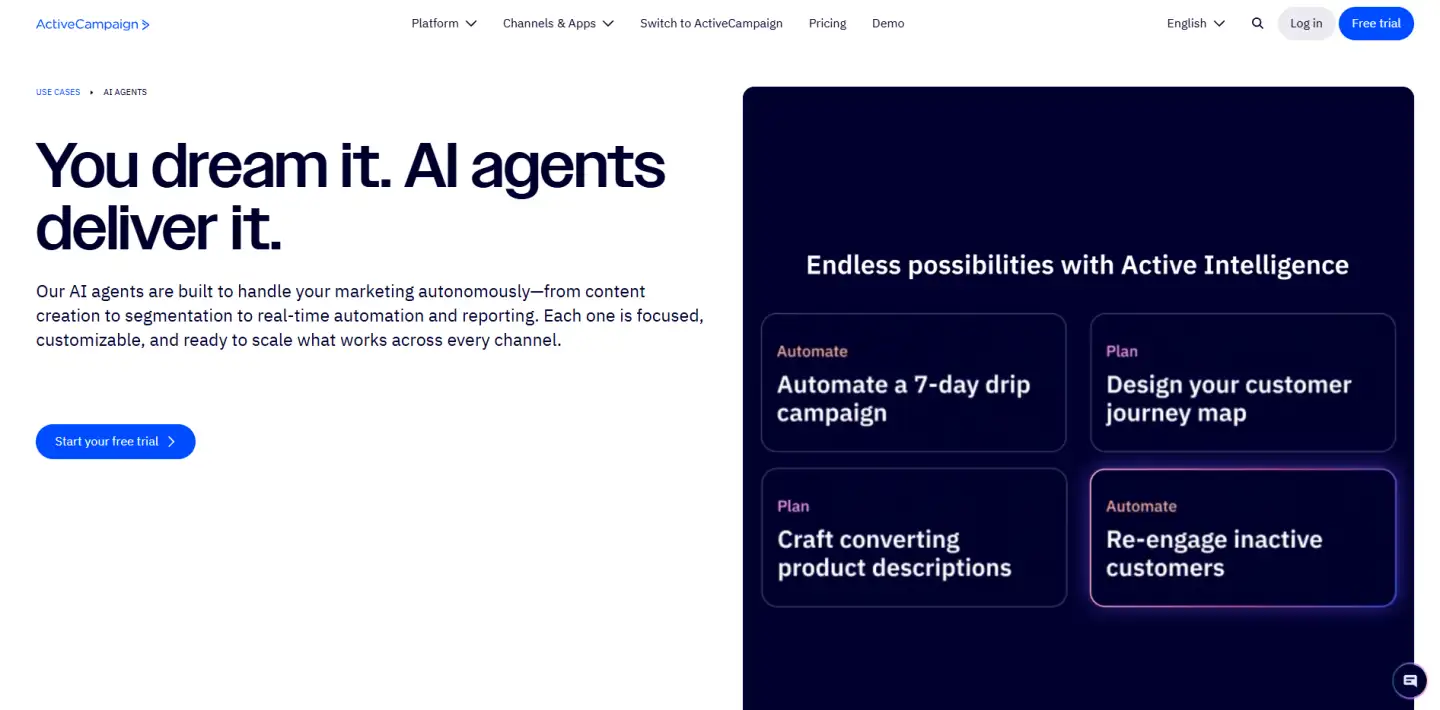
AI agents add a more proactive layer on top of traditional automation. Instead of manually defining every branch and waiting for a marketer to request the next task, you can describe a goal such as “welcome new subscribers and encourage a first purchase,” and AI can help prepare campaign drafts, surface relevant ideas, analyze account context, and recommend next steps based on historical performance and available marketing data. In ActiveCampaign, Active Intelligence 3.0: Wavelength goes further by using account history, automations, audience behavior, brand context, performance patterns, and relevant external signals to provide more account-specific assistance.
The key difference is proactive augmentation: AI can prepare work, surface insights, monitor activity, and recommend or execute supported actions, while humans provide strategy, review outputs, maintain brand direction, and retain control over important campaign decisions.
Why Businesses Are Moving Toward AI Email Marketing
Teams face familiar constraints: limited time, increasingly complex customer journeys, growing volumes of campaign data, higher expectations for relevance, and the need to identify what deserves attention next. AI assistance can help by preparing campaign ideas, analyzing performance, monitoring automations, handling recurring tasks, and surfacing useful recommendations before every step has to be initiated manually — allowing marketers to spend more time on strategy, offers, creative direction, and customer relationships.
Data quality, consent, deliverability, clear goals, and compelling offers remain foundational. Account-aware AI becomes more useful when it has reliable campaign history, customer context, brand information, and performance data to work with.
Why ActiveCampaign Stands Out for AI-Powered Email Marketing
ActiveCampaign stands out by combining email marketing, sophisticated automation, customer journeys, CRM capabilities, and extensive integrations with Active Intelligence 3.0: Wavelength. Rather than operating as a separate AI writing tool, Active Intelligence can use a shared context layer that brings together account history, automations, campaign performance, audience behavior, brand information, and relevant external signals. This allows its recommendations, drafts, monitoring, and actions to be grounded more closely in how a specific business actually markets.
Active Intelligence: What It Adds
Active Intelligence serves as the AI layer across ActiveCampaign, with Active Intelligence 3.0: Wavelength expanding it into more proactive, account-aware marketing intelligence. Its capabilities include:
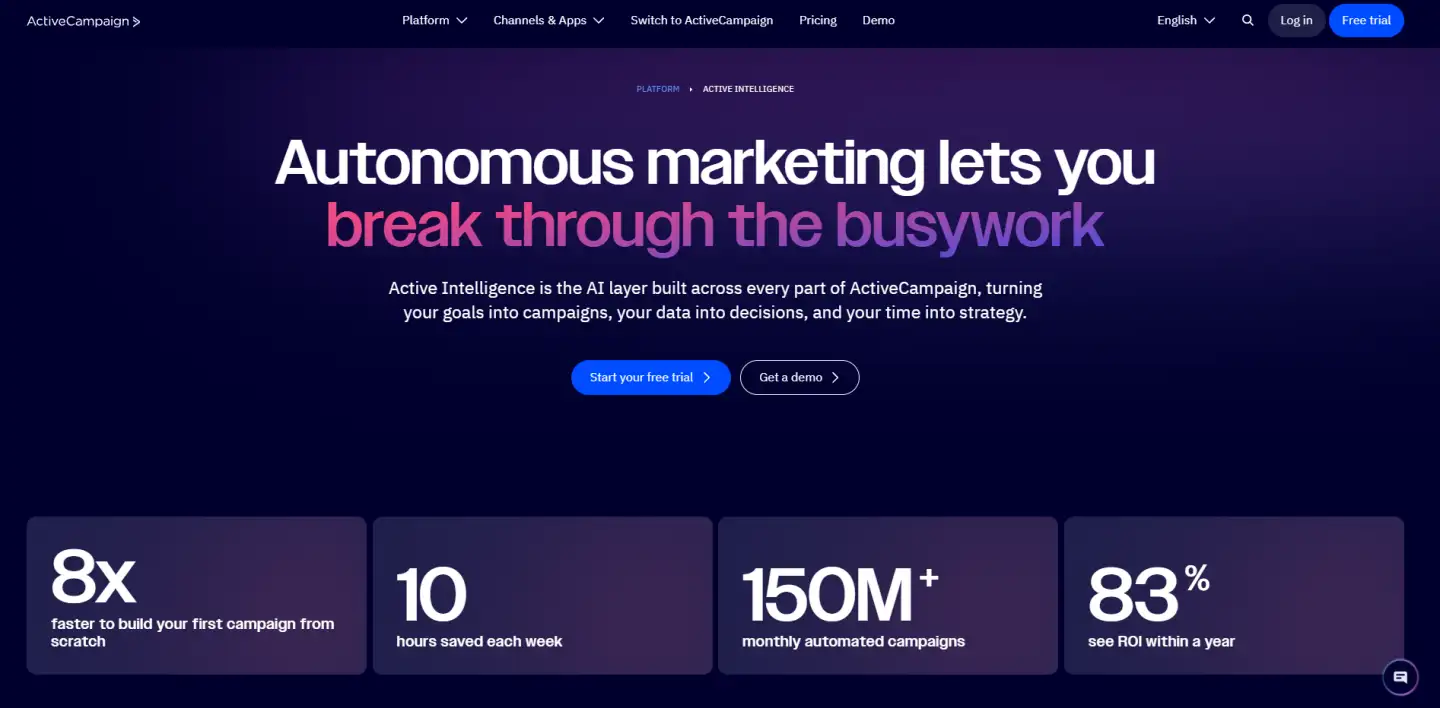
Proactive Drafts and Ideas: Helps prepare campaign concepts and draft content based on account activity, goals, and available context.
Adaptive Memory: Retains relevant account, brand, and marketing context so AI assistance can become more grounded in how a business actually works.
Content Performance: Uses past campaign performance to help marketers understand what has worked and inform future content decisions.
Scheduled Tasks: Allows supported AI-powered marketing tasks and monitoring activities to run on a recurring schedule.
Automation Insights and Automation Health: Helps identify patterns, issues, and areas that may need attention within existing automations.
External Intelligence, Brand Monitoring, AI-assisted content creation, translations, and other context-aware marketing capabilities.
These capabilities are designed to make AI more proactive and useful within the marketing workflow while keeping marketers responsible for strategy, brand direction, compliance, and important approvals. Availability of individual Active Intelligence 3.0: Wavelength capabilities can vary by account and rollout stage.
Practical Examples
Here’s how proactive, account-aware AI assistance can enhance common campaigns compared with purely traditional approaches.
Welcome Sequence Traditional: Manually build a drip series with fixed timing and predefined content. AI assistance: Use account and brand context to help prepare onboarding ideas, draft messaging, and surface relevant recommendations while the marketer controls the final journey.
Lead Nurturing Campaign Traditional: Run rule-based emails based on form submissions, tags, or other predefined conditions. AI assistance: Use campaign history and performance context to identify areas that may deserve attention, prepare new content ideas, and recommend improvements to the nurture experience.
Abandoned Cart or Checkout Recovery Traditional: Send a predefined reminder sequence after an abandonment trigger. AI assistance: Use brand context, previous campaign performance, and account data to help prepare message variations and surface opportunities to improve the recovery workflow.
Re-engagement Campaign Traditional: Send a standard campaign to contacts that meet predefined inactivity criteria. AI assistance: Analyze available account and content performance context to help prepare re-engagement ideas, messaging variations, and recommended next steps without claiming to predict which individual contacts will return.
Post-Purchase Follow-Up Traditional: Run a fixed thank-you and follow-up sequence. AI assistance: Use available brand, campaign, and customer context to help prepare follow-up ideas and identify areas of the journey that may benefit from additional attention.
Upsell or Cross-Sell Campaign Traditional: Build segments and offers manually using predefined customer criteria. AI assistance: Use historical campaign context and performance patterns to help develop relevant campaign ideas, audience approaches, and messaging for marketer review.
5-Step Framework for Using AI Agents in Email Marketing
Define the Campaign Goal — Be specific about the outcome you want to improve, such as repeat purchases, onboarding engagement, or reactivation.
Clean and Organize Customer Data — Maintain reliable lists, integrations, consent records, account information, and brand context.
Build the Customer Journey — Establish a clear automation foundation so AI has meaningful workflows and campaign history to work with.
Use AI for Context-Aware Drafts, Insights, Monitoring, and Recommendations — Let Active Intelligence help prepare work and surface useful next steps based on available account context.
Review, Test, and Optimize with Human Judgment — Validate AI outputs, maintain compliance and brand standards, approve important actions, and monitor campaign results.
Where ActiveCampaign Helps Most
It can be particularly useful for ecommerce brands managing multiple lifecycle campaigns, SaaS companies nurturing trials and customers, agencies working across complex client accounts, course creators running recurring launches, and B2B teams handling longer sales cycles. The combination of marketing automation, CRM capabilities, customer journeys, and Active Intelligence 3.0: Wavelength becomes more valuable when a business already has meaningful campaign history, customer data, and recurring marketing activity that AI can use as context.
For these teams, the biggest advantage is not simply sending more emails. It is building more responsive customer journeys that use engagement, account history, campaign performance, and customer data as context. Instead of treating every contact or campaign the same, ActiveCampaign can help businesses organize customer information, trigger relevant automations, monitor marketing activity, and use account-aware AI insights to improve messaging and identify useful next steps.
That makes it especially useful for companies that want email marketing to support the full customer lifecycle, from first signup and onboarding to repeat purchases, renewals, re-engagement, and long-term retention.
Where ActiveCampaign May Be More Than You Need
For very small lists, occasional simple newsletters, or teams that are not yet ready to manage automations, integrations, and customer data, a lighter email tool may be sufficient. Limited campaign history or poor data quality can also reduce how much value account-aware AI can provide.
ActiveCampaign Pros and Considerations
Pros
Deep automation and customer journey capabilities
Active Intelligence for proactive, account-aware AI assistance across marketing workflows
CRM capabilities combined with customer, engagement, and campaign data
Proactive drafts, automation insights, content performance analysis, scheduled tasks, and external intelligence
Extensive integration ecosystem
Strong focus on lifecycle marketing, automation, and context-aware campaign support
Considerations
Advanced automations and AI capabilities can require time to configure and learn effectively
Pricing varies based on plan, contact volume, and selected capabilities
AI-generated drafts, recommendations, and actions should still be reviewed for accuracy, tone, strategy, and compliance
Best results depend on reliable customer data, useful account history, and clear marketing goals
Availability of individual Active Intelligence capabilities can vary by account, plan, permissions, and rollout stage
Pricing, packaging, and feature availability can change, so current account-specific details should be checked directly before making a purchasing decision.
Who Should Consider ActiveCampaign?
ActiveCampaign is particularly relevant for teams that are ready to invest in automation, have meaningful customer and campaign data, and manage goals that benefit from multi-step lifecycle journeys. It can be a strong fit for growing businesses that want email marketing, automation, CRM workflows, customer data, and proactive AI assistance to work together within one marketing environment.
Who Might Prefer a Simpler Email Tool?
Solopreneurs sending infrequent broadcasts, businesses with very small lists, or teams prioritizing maximum simplicity over advanced automation, customer data integration, and AI-assisted workflows may find a lighter email platform easier to manage.
Final Verdict
AI agents in email marketing can help teams work more proactively by assisting with campaign preparation, content, monitoring, analysis, and optimization while human marketers remain essential for strategy, brand direction, compliance, and final decisions. ActiveCampaign with Active Intelligence 3.0: Wavelength brings these capabilities together with email automation, customer journeys, CRM data, account history, and performance context. It is not an unchecked autopilot, but it can be a strong option for growing teams that want AI to move beyond responding to prompts and become a more proactive part of their marketing workflow.
FAQ
Specialized AI tools that assist with campaign planning, content generation, segmentation, personalization, timing, and performance analysis.
Traditional automation follows manual rules you create. AI agents provide intelligent recommendations, generate elements, and adapt based on data.
No. AI handles repetitive or data-heavy tasks, but strategy, creativity, brand voice, and final decisions remain human responsibilities.
It offers robust email marketing with AI capabilities powered by Active Intelligence, including campaign building, predictive features, and insights.
The platform’s AI engine that powers agents for insights, campaign creation, automation suggestions, content, and optimization across marketing activities.