


Deel and Rippling are two of the most widely used platforms for companies that want to manage hiring, payroll, HR operations, contractors, compliance, and workforce administration in one place. At first glance, they look similar: both support international hiring, payroll workflows, employee data, onboarding, contractor management, and compliance-related processes.
However, they are not built around the same core idea.
Deel is primarily built for global employment infrastructure. Its strongest use cases are international hiring, Employer of Record services, contractor management, global payroll, local compliance support, immigration, benefits, and managing distributed teams across multiple countries. It is especially useful when a company wants to hire people abroad without setting up local legal entities in every market.
Rippling is broader. It combines HR, payroll, IT, finance, identity management, app access, device management, expenses, workflows, reporting, and automation. Instead of focusing only on global employment, Rippling uses employee data as the central record that can trigger actions across different departments.
That difference matters. A company that mainly needs to hire international employees and contractors may prefer Deel because it is more focused on global payroll and compliance. A company that wants to connect HR, IT, finance, payroll, apps, devices, and permissions in one operating system may prefer Rippling.
This comparison uses a structured framework across key evaluation criteria: pricing structure, country coverage, EOR and global payroll, contractor management, compliance support, platform user experience, integrations, IT automation, customer support, and scalability.
Deel vs Rippling: Quick Comparison
Feature |
Deel |
Rippling |
|---|---|---|
Best for |
Global hiring, EOR, contractors, global payroll, international compliance |
Unified HR, payroll, IT, finance, apps, devices, and automation |
Core strength |
Global employment infrastructure |
Workforce operating system |
Country coverage |
Available in 160+ countries; EOR and payroll coverage depends on product and country |
Products work across 185+ countries and 50+ currencies; coverage depends on product and setup |
EOR |
Yes, strong global focus with public starting pricing |
Yes, connected with HR, payroll, IT, and compliance workflows |
Global payroll |
Strong focus; designed for multi-country payroll and payments |
Strong for companies that want payroll connected to HR data, benefits, approvals, and reporting |
Contractor management |
Very strong; one of Deel’s main use cases |
Strong; contractors can be managed in the same workforce system as employees |
Pricing transparency |
More public starting prices for key products |
Mostly quote-based and modular |
IT and device management |
Available through Deel IT, but not the main reason most companies choose Deel |
One of Rippling’s strongest areas |
Best fit |
Remote-first, international, and contractor-heavy teams |
Companies that want one system for HR, IT, payroll, finance, and automation |
Scoring Matrix: Deel vs Rippling
Evaluation Criteria |
Deel Score |
Rippling Score |
Why It Matters |
|---|---|---|---|
Pricing transparency |
5/5 |
3/5 |
Deel lists several starting prices publicly, while Rippling usually requires a quote. |
Country coverage |
5/5 |
5/5 |
Both support global teams, although availability depends on the product, country, and worker type. |
EOR and global hiring |
5/5 |
4/5 |
Deel is more global-hiring-first; Rippling is strong but broader in scope. |
Contractor management |
5/5 |
4/5 |
Deel is especially strong for contractor payments, agreements, invoices, and compliance workflows. |
IT and automation |
3/5 |
5/5 |
Rippling has deeper native IT, device, identity, and app-access workflows. |
Platform breadth |
4/5 |
5/5 |
Rippling covers HR, IT, finance, payroll, and automation in a more unified operating model. |
These scores are not meant to say that one platform is universally better. They show which platform is likely to fit different business priorities. Deel scores higher when the main requirement is international hiring, contractor management, payroll, and compliance. Rippling scores higher when the company needs one system to connect HR data with IT, finance, payroll, access control, and internal workflows.
What Is Deel?
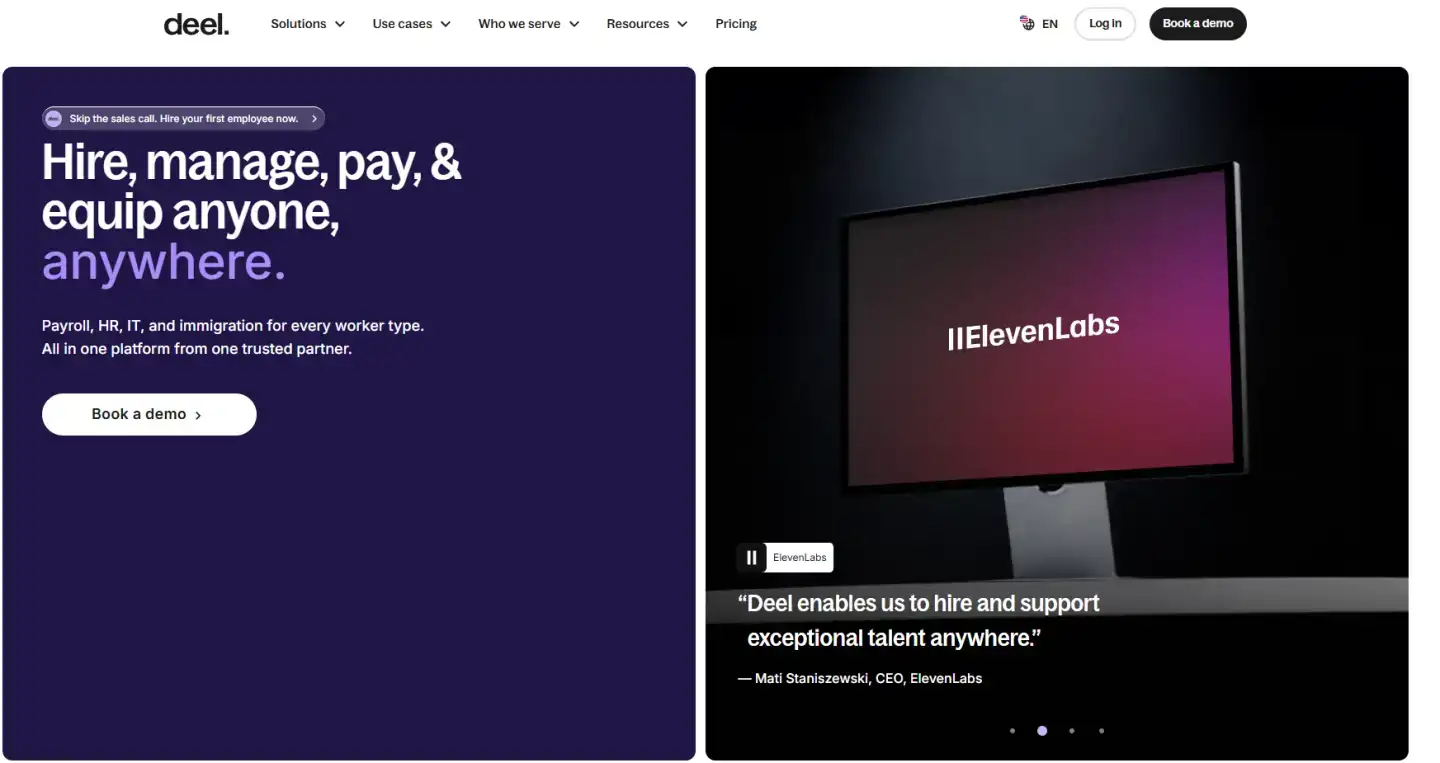
Deel is a global HR, payroll, and compliance platform designed for companies that hire across borders. It helps businesses manage international employees, contractors, payroll, tax documentation, benefits, employment contracts, immigration needs, and local compliance requirements.
Its strongest use cases are Employer of Record, contractor management, global payroll, and distributed workforce operations. This makes Deel especially useful for remote-first companies, startups, agencies, SaaS companies, marketplaces, and international businesses that want to hire talent in different countries without building a separate legal entity in every location.
For example, if a company based in the United States wants to hire a full-time employee in Spain, contractors in Ukraine, and developers in Brazil, Deel can help manage employment documents, contractor agreements, payments, tax forms, compliance workflows, benefits, and local employment requirements from one platform.
Deel is also useful for companies with mixed teams. Many modern companies do not have only one type of worker. They may have local employees, international employees, EOR employees, contractors, freelancers, and remote specialists. Deel gives these companies a way to manage different worker types without relying on separate payroll vendors, manual spreadsheets, and country-specific processes for every market.
What Is Rippling?
Rippling is a workforce management platform that connects HR, payroll, IT, finance, and automation. Instead of focusing only on hiring people internationally, Rippling uses employee data as the foundation for many operational workflows across the business.
When a new employee joins the company, Rippling can help with onboarding, payroll setup, benefits enrollment, app access, device management, security permissions, time tracking, approvals, expenses, and reporting. When that employee changes role, moves country, changes department, or leaves the company, the same employee record can trigger updates across systems.
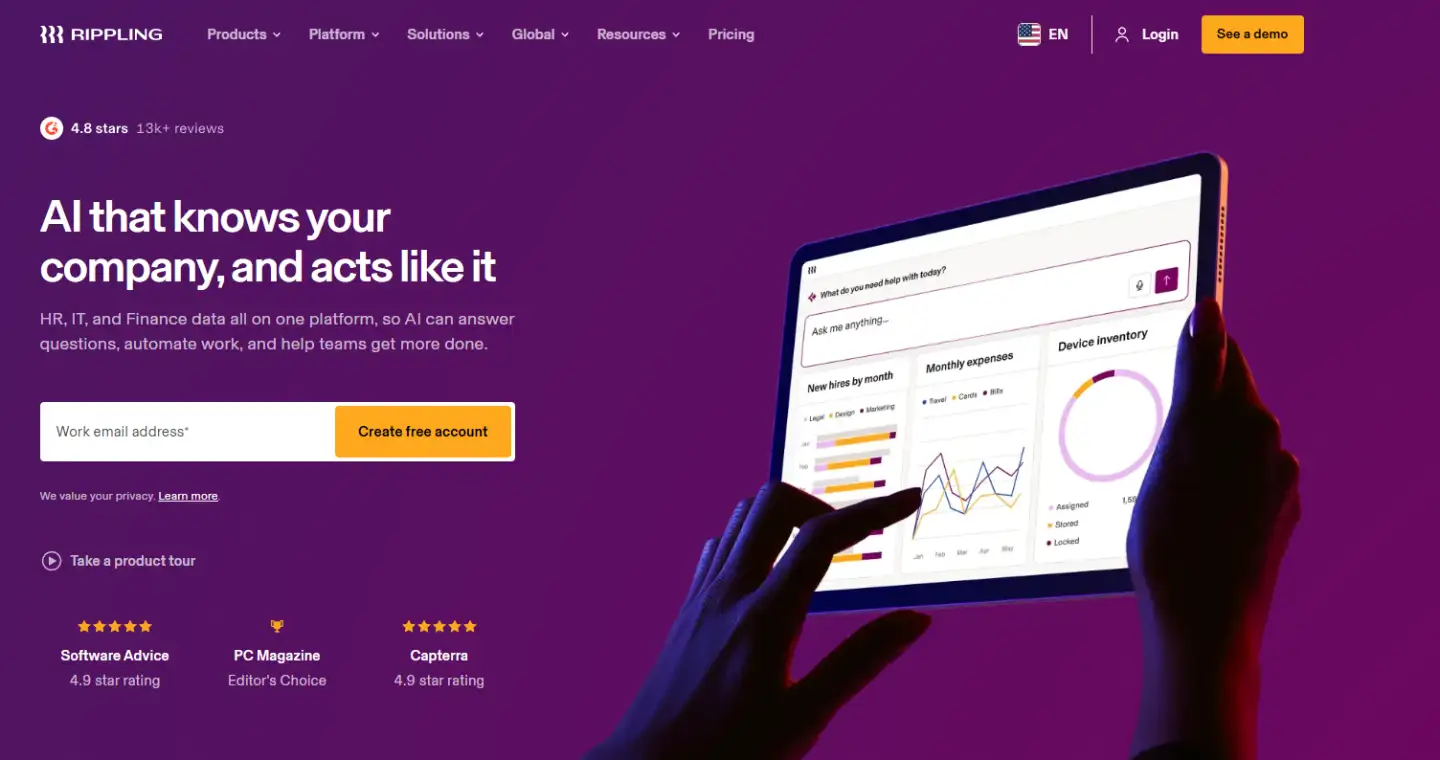
This is why Rippling is often described as more than a standard HR tool. It is closer to a workforce operating system for companies that want to connect the employee lifecycle with internal operations. That can be valuable for businesses that use many software tools, manage remote devices, need stronger access control, or want to reduce manual work between HR, IT, finance, and payroll teams.
Rippling can also support global hiring, global payroll, contractors, and EOR employees. The difference is that global workforce management is one part of a broader product ecosystem. Companies that already want Rippling for HRIS, IT management, identity management, finance workflows, and automation may find it convenient to manage global payroll and EOR inside the same platform.
Evaluation Criteria
To compare Deel and Rippling fairly, it is important to use a structured framework instead of only looking at feature lists. Both platforms are broad, and both can support global teams, but they solve different problems. The best choice depends on what your company needs most.
1. Pricing Structure
Pricing is one of the clearest differences between the two platforms.
Deel publishes starting prices for several major products. For example, its public pricing page lists starting prices for contractor management, Contractor of Record, global payroll, Employer of Record, PEO, Core HR, and Deel IT products. The final cost can still depend on country, headcount, worker type, services, add-ons, and contract terms, but Deel gives buyers more information before they contact sales.
Rippling uses a modular pricing model. Businesses can buy HR, payroll, IT, finance, global, and platform products depending on what they need. Rippling’s pricing page emphasizes a custom quote rather than a full public price list. This can be flexible because a company does not have to buy every module, but it can also make early budgeting harder before a sales conversation.
Winner: Deel for upfront pricing clarity. Rippling may still be cost-effective for companies that want several modules, but buyers usually need a custom quote to understand the full price.
2. Country Coverage
Both Deel and Rippling are built for global workforces, but their coverage should be evaluated by product, not only by headline country count.
Deel is available in more than 160 countries and presents itself as a platform for hiring, paying, and managing global teams. Deel’s global payroll, EOR, contractor, and compliance products are especially relevant for companies that want to hire across borders. However, exact support can vary by country, worker classification, payment method, legal model, and service type.
Rippling says its products work across 185+ countries and 50+ currencies. Its global contractor product supports onboarding contractors in 185+ countries, and its broader platform connects global hiring with HR, payroll, IT, and finance operations. As with Deel, companies should verify coverage for the specific country and product they need because EOR, local payroll, contractor payments, and benefits may not have identical availability everywhere.
Winner: Tie. Deel is especially strong for global employment infrastructure. Rippling is especially strong when global coverage needs to connect with HR, IT, finance, and automation.
3. EOR and Global Hiring
Employer of Record services are important when a company wants to hire full-time employees in a country where it does not have its own local legal entity. In that model, the EOR becomes the legal employer for administrative purposes, while the client company manages the employee’s day-to-day work.
Deel is one of the stronger options for EOR because global hiring is central to its product identity. Deel can help with local employment contracts, payroll, statutory benefits, tax filings, onboarding, legal requirements, and HR support. Its public pricing page also gives a starting EOR price, which helps companies estimate the cost of entering a new market.
Rippling also offers EOR services and can help companies hire in new countries without opening an entity. Its advantage is the connection between EOR and the rest of the workforce system. For example, an EOR employee can be connected to onboarding workflows, payroll, app provisioning, benefits, reporting, and permissions in the same platform.
Winner: Deel for global hiring simplicity and focus. Rippling for companies that want EOR connected to broader internal operations.
4. Payroll
Payroll is one of the most important comparison points because errors in payroll can create financial, legal, and employee experience problems. A good global payroll system should support local tax rules, statutory deductions, payslips, reporting, currencies, approvals, and integrations with HR and accounting systems.
Deel has a strong global payroll product and is built for companies that pay employees and contractors across multiple countries. It is especially useful for companies that already have entities in some countries but want a managed payroll solution that can handle local filing, reporting, country-specific calculations, and multi-currency payments.
Rippling also offers global payroll. Its main advantage is how payroll connects to employee data, time tracking, benefits, approvals, and reporting. When HR data changes, payroll-related workflows can update through the same system. This can be valuable for companies that want fewer manual handoffs between HR and payroll teams.
Winner: Deel for companies prioritizing global payroll as a standalone international operation. Rippling for companies prioritizing payroll automation inside a broader HR, IT, and finance ecosystem.
5. Contractor Management
Contractor management is one of Deel’s strongest areas. Companies can use Deel to create contractor agreements, collect tax documents, manage invoices, approve payments, support multiple currencies, and reduce misclassification risk through structured workflows. This is especially helpful for companies that rely heavily on freelancers, agencies, developers, consultants, or international contractors.
Rippling also supports global contractors. It allows companies to onboard contractors, collect information, generate or approve invoices, pay in multiple currencies, and manage contractors in the same system as employees. The practical advantage is operational consistency: contractors can be included in access, approvals, reporting, and workforce workflows.
Winner: Deel for contractor-first teams. Rippling for companies that want contractors managed alongside employees, apps, permissions, and workflows.
6. Compliance Support
Compliance is one of the main reasons companies choose platforms like Deel or Rippling instead of trying to manage global hiring manually. International employment involves local labor laws, tax rules, statutory benefits, payroll deadlines, worker classification, contracts, data protection, immigration, and country-specific documentation.
Deel’s compliance value is strongest in global employment scenarios. It is designed to help companies manage local contracts, payroll requirements, EOR obligations, contractor classification, tax forms, benefits, and country-specific documentation. This is useful when a company is expanding into markets where it does not have internal legal or payroll expertise.
Rippling’s compliance value is broader across internal operations. In addition to payroll and global hiring compliance, Rippling can help automate access rules, permissions, employee lifecycle policies, training, approvals, device controls, and HR workflows. This matters for companies that see compliance not only as a payroll issue but also as an operational control issue across HR, IT, and finance.
Winner: Deel for international employment compliance. Rippling for operational compliance across workforce systems.
7. Platform UX and Ease of Use
User experience depends on the team’s needs. Deel is generally easier to understand if the main goal is hiring and paying international workers. The platform is organized around practical global workforce tasks: hire a worker, create a contract, collect documents, run payroll, approve contractor invoices, manage compliance, and support payments.
Rippling can feel more powerful but also more layered because it covers more departments. The platform becomes especially valuable when a company wants employee data to control many actions: onboarding, app access, device setup, payroll changes, approvals, benefits, expenses, security permissions, and reporting. For teams that only need global hiring or contractor payments, this wider system may be more than necessary. For companies with complex internal operations, the broader UX can be a major advantage.
Winner: Deel for simpler global hiring workflows. Rippling for companies that want a deeper operational system across departments.
8. Integrations, IT, and Automation
This is where Rippling clearly stands out. Rippling includes products for identity and access management, device management, inventory, app provisioning, SSO, permissions, workflows, analytics, and finance operations. It also supports a large integration ecosystem, which makes it useful for companies that want to connect people data with many business systems.
For example, when an employee is hired, Rippling can help provision apps, assign a device, set permissions, add the person to payroll, and trigger onboarding workflows. When the person leaves, it can help remove access, start offboarding, update payroll, and manage device return processes. This can reduce manual work and improve security.
Deel also offers integrations and has expanded into IT-related tools, including device and access workflows through Deel IT. However, Deel’s central advantage remains global employment, payroll, EOR, contractor management, and compliance. Companies should not choose Deel mainly because they want a deep IT operating system; they should choose it when global hiring and payroll are the priority.
Winner: Rippling.
9. Customer Support
Support matters because payroll, onboarding, EOR, and compliance issues are often time-sensitive. Both platforms provide support resources, help centers, and in-platform support paths, but the support experience can vary by plan, region, issue complexity, and customer size.
Deel emphasizes global support and lists 24/7 support for its EOR product. This is important for distributed teams working across time zones. Deel also provides in-platform support access through its help and communication tools.
Rippling provides support through its platform and publishes support status information, including response-time metrics and the ability for customers to convert live chat into a virtual call. This is useful for teams that need help with HR, payroll, IT, or finance workflows.
Winner: Tie. Deel has an advantage for global employment support, while Rippling has an advantage for companies that need support across HR, IT, payroll, and finance systems.
Pricing Comparison
Deel is generally easier to evaluate upfront because it publishes starting prices for many core products. Public starting prices include contractor management, Contractor of Record, global payroll, Employer of Record, Core HR, and several Deel IT modules. This does not mean every company will pay the same amount. Final pricing can depend on country, headcount, product mix, worker type, payment method, implementation needs, and negotiated contract terms.
Rippling is more quote-based. Its pricing model is modular, and companies can select the products they need across HR, payroll, IT, finance, global, and platform capabilities. This can be efficient for companies that want a tailored setup, but it makes it harder to estimate cost without contacting sales.
In simple terms, Deel is usually easier for early price comparison. Rippling is better evaluated as a bundled operating system where total value depends on how many workflows it replaces or automates.
Deel Pros
Deel is excellent for international hiring, EOR, contractor management, global payroll, and compliance support. It is a strong choice for companies that hire across borders and want a focused platform for managing employees and contractors in multiple countries.
Deel is also easier to evaluate from a pricing perspective because many starting prices are publicly available. For companies comparing vendors before booking sales calls, this transparency can save time. Deel is especially practical for remote-first companies, startups, agencies, and global teams that want to move quickly into new markets.
Deel Cons
Deel may not be the best fit if the company’s main need is deep IT automation, advanced device management, app provisioning, finance workflows, or a single operating system for every internal department. Deel does offer HR and IT-related capabilities, but its strongest identity is still global employment infrastructure.
Deel can also become expensive when a company uses EOR for many employees across several countries. This is not a Deel-specific weakness; EOR services are generally more expensive than hiring through your own entity because the provider takes on legal employment, payroll administration, benefits, compliance, and local infrastructure responsibilities.
Rippling Pros
Rippling is powerful because it connects HR, payroll, IT, finance, apps, devices, permissions, and workflows in one platform. This is valuable for companies that want to automate onboarding, offboarding, access management, payroll changes, reporting, expenses, and internal approvals.
Rippling is also strong for companies with complex software environments. If employees need access to many apps, devices, security policies, approval flows, and finance tools, Rippling can reduce manual work between HR and IT. Its value grows as more departments use the platform together.
Rippling Cons
Rippling can be more complex to evaluate and implement because it covers many functions. A company that only needs global contractor payments or EOR may not need the full Rippling ecosystem.
Pricing is also less transparent upfront because Rippling generally uses custom quotes. That does not mean Rippling is automatically more expensive, but it does mean buyers need to speak with sales to understand the full cost of the modules they want.
Which Platform Should You Choose?
Choose Deel if your main priority is hiring and paying people internationally. It is a strong choice for companies that work with global employees, contractors, and remote teams. Deel is especially useful if you need EOR, contractor compliance, global payroll, international payments, local employment support, and clear public starting prices.
Choose Rippling if your company wants one system for HR, payroll, IT, finance, and automation. It is better for businesses that want employee data to automatically control app access, devices, permissions, payroll, expenses, reporting, and workflows.
The simplest way to decide is this:
Deel is better for global hiring and payroll. Rippling is better for full workforce operations.
Final Verdict
Deel and Rippling are both strong platforms, but they solve different problems.
Deel is the better fit for companies that need a focused solution for international hiring, contractors, EOR, global payroll, and compliance. It is practical, global-first, and easier to evaluate from a pricing perspective. For companies that want to hire across borders quickly, manage international contractors, and reduce the operational burden of country-specific payroll and employment rules, Deel is usually the stronger starting point.
Rippling is the better fit for companies that want to centralize HR, IT, finance, payroll, and automation in one system. It offers more operational depth, especially for businesses that rely on many apps, devices, permissions, approvals, and cross-department workflows. For companies that want to build an internal operating system around employee data, Rippling may be the better long-term platform.
Overall, the choice should not be based on which platform has the longest feature list. It should be based on your company’s main problem. If the problem is global hiring, EOR, contractors, payroll, and international compliance, choose Deel. If the problem is connecting HR, IT, finance, payroll, devices, apps, and workflows across the whole company, choose Rippling.