

Almost every AI feature shipped into marketing platforms over the last three years follows the same pattern: you open a chat box, type what you want, and get something back. It's a useful pattern, but it's still fundamentally reactive — the system knows nothing until you tell it. Active Intelligence 3.0: Wavelength, ActiveCampaign's first named AI release, is built around a different premise: an AI layer that's expected to already know what's going on inside a specific account, and to say something before being asked.
That's a bigger claim than it sounds. Most so-called smart marketing tools are smart about language, not about your account.
Wavelength is grounded in a business's own send history, automation structure, performance patterns, and brand voice, and it's designed to act on that context on its own initiative — drafting, monitoring, and flagging without a prompt kicking things off. Below is a practitioner-level walkthrough of what each piece actually does, where it earns its keep, and where it still falls short of the marketing.
Why the Framing Matters: Reactive vs Proactive AI
The broader martech category has spent the last two years converging on generative AI — write this email, summarize this segment, generate this image. That's useful, but it puts the burden of initiative entirely on the marketer: you still have to know what to ask for. The next competitive layer in the category is agentic and proactive AI — systems that monitor state and surface action items on their own, the way a good ops person would flag a stalled process without being asked to check it.
Wavelength is ActiveCampaign's entry into that second category. It doesn't replace the earlier generative experience — the memory, Brand Kit voice and tone controls, and custom instructions that shipped in prior versions are still the foundation many accounts run on. What changes with Wavelength is initiative: the system is designed to notice things and act, not just respond well when asked.
Adaptive Memory: The Layer Everything Else Runs On
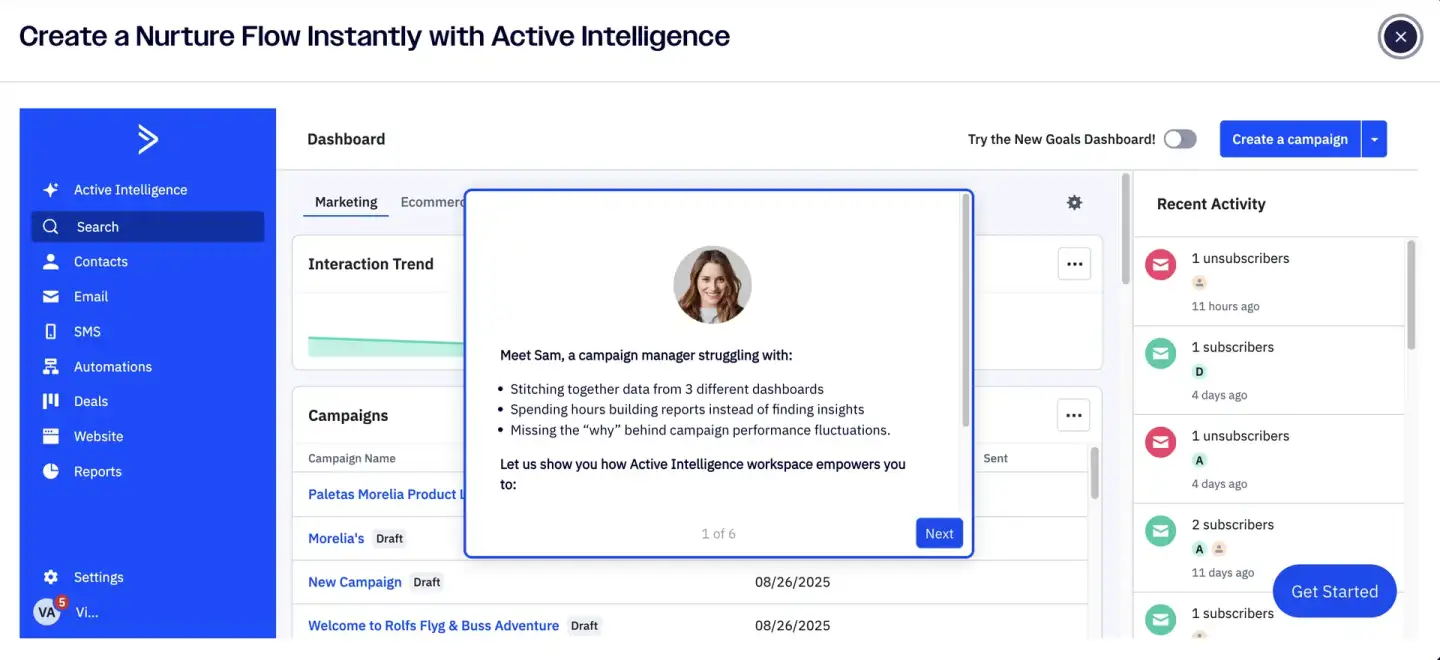
Adaptive memory doesn't look impressive in a feature list, but it's the dependency every other capability here relies on. Instead of treating each AI interaction as a cold start, the system is designed to carry context forward — the tone you've already corrected it on, the campaigns that have already converted, the patterns specific to that audience.
In practice, this is what separates AI that writes fine copy from AI that writes copy that sounds like this business. A generic LLM prompt produces generic output; account-grounded memory is the mechanism that's supposed to close that gap.
Proactive Drafts and Ideas: Removing the Blank-Page Problem
This is the most visible day-to-day change. Instead of a marketer typing a prompt like give me a campaign idea, Wavelength is designed to generate a draft unprompted — informed by what has already performed well in that account, and tied to relevant dates where applicable.
The practical value here isn't the writing quality; it's the removal of a specific failure mode every marketing team knows: the good idea that never gets built because nobody had thirty free minutes to start from zero.
A mid-size e-commerce brand with a soft week in email revenue, for example, is a textbook case where a proactive draft — even a rough one — changes whether a win-back sequence goes out this week or gets pushed to someday. Editing something is a fundamentally lower-friction task than creating it.
Scheduled Tasks: Turning a One-Off Prompt Into Infrastructure
Scheduled Tasks let a marketer convert a recurring manual check into a standing instruction — set up once, run indefinitely. The canonical example is a weekly performance review that identifies one thing worth testing next, delivered automatically instead of depending on someone remembering to run it.
The unglamorous truth about most marketing best practices — regular list hygiene checks, weekly performance reviews, automation audits — is that they get skipped under deadline pressure, not because teams don't know they matter. Turning that into scheduled, standing AI output is a direct fix for that specific failure pattern, not a novelty.
External Intelligence: Closing the Blind Spot Around Your Own Account
Account data can only tell you what your own contacts did. It can't tell you a competitor just changed their pricing page, or that your own site's messaging shifted in a way your live campaigns haven't caught up to yet. External intelligence is built to close that specific gap — tracking relevant external signals, including changes to a business's own website and competitor activity, and surfacing them as recommendations instead of leaving a marketer to notice by accident.
This is the capability most likely to justify itself on ROI alone, because the failure it prevents — running a campaign against stale positioning, or missing a window a competitor just opened — is invisible until it's already cost you the quarter. If you want to see how this behaves against your own account data rather than a demo, ActiveCampaign's trial connects Wavelength directly to your real account from day one, so the recommendations aren't generic.
Automation Insights and Automation Health: The Silent Revenue Leak
This is the capability that gets the least attention and probably deserves the most. A trial-to-paid nurture sequence with one silently broken conditional step doesn't fail loudly — it just quietly stops converting a segment of leads, for weeks, until someone happens to audit it.
Automation Insights and Automation Health are built to monitor for exactly that pattern: a stalling step, a broken branch, a journey that's technically active but functionally dead — and flag it before more contacts move through the gap.
Marketers tend to treat automation-building as a one-time setup task rather than something that needs ongoing monitoring, the same way nobody re-checks a thermostat once it's installed. That's precisely the gap this capability targets, and it's arguably a bigger lever on revenue than anything related to copywriting.
Content Performance and Brand Monitoring: Feeding the Loop
Two supporting capabilities round this out. Content performance feeds outcomes back into the system, so future recommendations are shaped by what's actually converted for that specific account rather than generic industry benchmarks.
Brand monitoring keeps messaging aligned when a business's own positioning or site content changes, so future campaigns don't quietly drift out of sync with what the business is actually saying elsewhere.
What a Week Running on Wavelength Looks Like
Monday: A Scheduled Task delivers last week's campaign performance summary without anyone requesting it.
Tuesday: Content performance surfaces a pattern in what's converted recently.
Wednesday: External intelligence flags a competitor or market shift worth reacting to.
Thursday: Proactive drafts and ideas prepares a campaign concept built on the above.
Friday: Automation Insights catches a stalled step in a customer journey before more contacts hit it.
No single day here is dramatic. The value is cumulative: none of it required opening a fresh AI conversation and re-explaining the business from scratch.
A 30-Day Starting Checklist
For teams evaluating this rather than reading about it, the useful first move isn't exploring every feature at once — it's giving the system enough account signal to be useful:
Audit your account history depth first. Wavelength's output quality is directly tied to how much campaign and automation history exists to learn from; a brand-new account will see a thinner version of everything described here.
Set up one Scheduled Task before touching anything else — a weekly performance review is the lowest-risk starting point.
Run an Automation Health check on your oldest live automations, not your newest ones. Stalled steps accumulate quietly over time.
Correct the AI's brand voice output early and explicitly rather than accepting the first draft, since adaptive memory is designed to carry those corrections forward.
Treat the first month of proactive drafts as calibration, not final copy — the value compounds as the system has more of your own outcomes to learn from.
What Wavelength Doesn't Do
Worth stating plainly, because this isn't a set-it-and-forget-it system:
It doesn't claim to predict individual customer behavior or purchase intent — it works from historical account patterns, not forecasting.
Every draft and recommendation still requires human review before it ships; nothing here sends itself.
Capability access varies by account and plan, so what's described here may not match every account exactly.
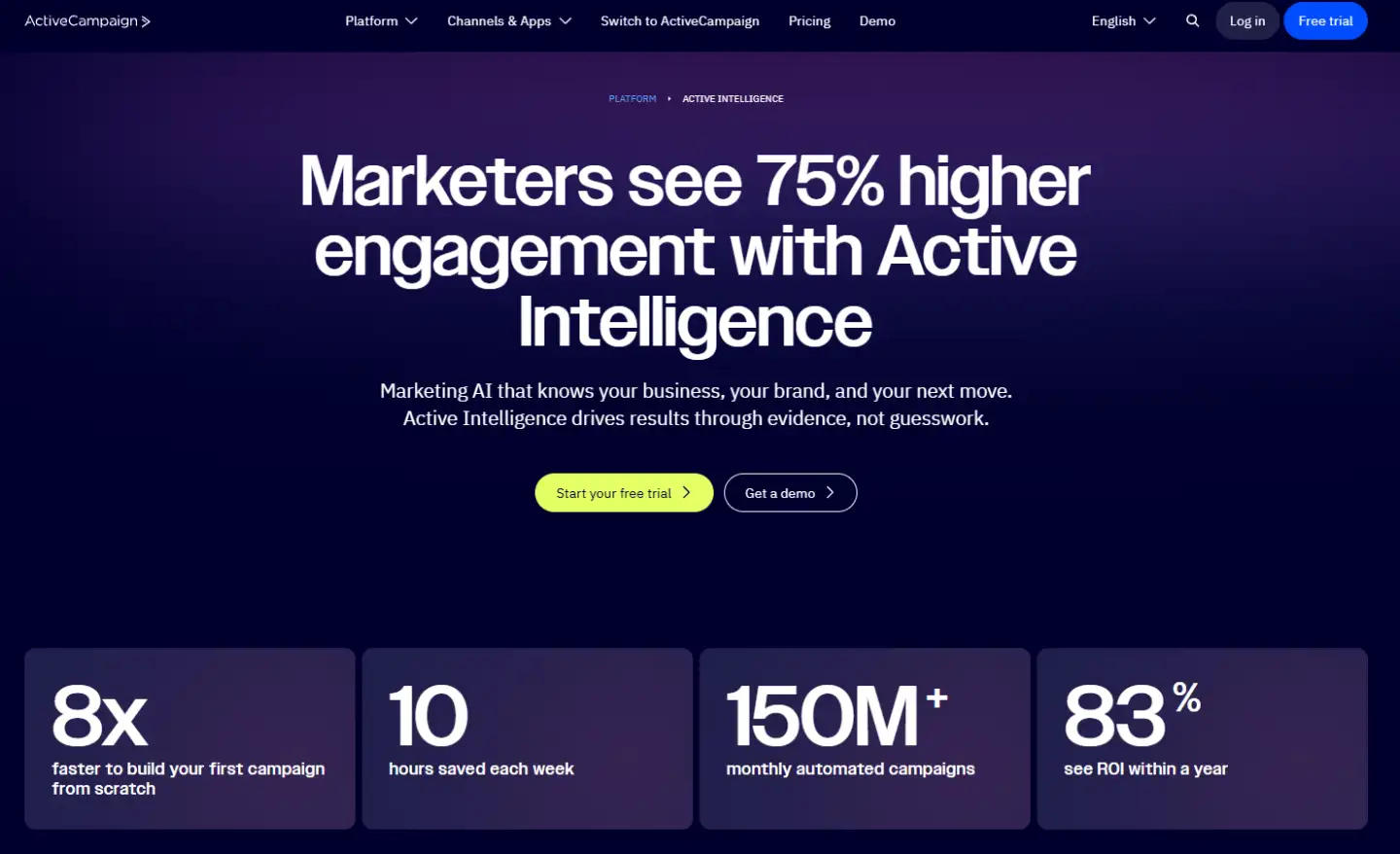
Several of the performance statistics circulating in early coverage of this release are still being finalized internally by ActiveCampaign. Treat headline numbers as directional until the company publishes verified figures, rather than repeating them as settled fact.
Who This Actually Fits
Because Wavelength leans on account history, automation structure, and performance data to function, it delivers more value the more marketing activity already exists behind it. A team running a handful of live automations and regular campaigns has real signal for the system to work with immediately.
A brand-new account, by contrast, is effectively giving Wavelength very little to learn from in month one — which isn't a flaw so much as a reasonable expectation to set going in.
Bottom Line
The meaningful shift with Active Intelligence 3.0: Wavelength isn't that ActiveCampaign's AI generates more things. It's that the system is built to already understand what's happening inside a specific account — its history, its patterns, its brand — before anyone has to explain it in a prompt.
That's a materially different relationship with marketing AI than the copy-generation tools most teams are used to, and it's worth testing against your own account data rather than judging from a demo. You can start here.
FAQ
Yes. Signal House positions itself as a Twilio alternative focused particularly on business SMS and MMS, with lower published SMS pricing, A2P onboarding, integrations and human support.
For standard U.S. outbound SMS, Signal House currently publishes a starting rate of $0.0065 per segment, compared with Twilio's standard published rate of $0.0083 per outbound long-code segment. Signal House's rate falls to $0.0030 at more than 10 million monthly segments. Carrier fees and other costs may apply to both providers.
Yes. Signal House says live human support is included on every plan, with a dedicated Slack channel available for customers sending at least 500,000 segments per month.
Signal House promotes Voice APIs on its homepage, but its current product navigation also lists Voice as an upcoming product. Businesses specifically requiring Voice should verify current production availability directly with Signal House.