

Twilio has long been one of the best-known communications API platforms. Its broad ecosystem makes it a strong option for developer-led companies that need SMS, voice, authentication, and other programmable communications tools.
But businesses that primarily rely on SMS often care about a different set of priorities: messaging costs, A2P registration speed, deliverability, ease of implementation, and access to responsive support.
Signal House is positioning itself as a Twilio alternative built around those needs. The platform focuses heavily on business messaging, including SMS and MMS APIs, straightforward volume-based pricing, faster A2P onboarding, simpler integrations, and hands-on customer support.
So how does Signal House compare with Twilio in 2026?
Signal House vs Twilio at a Glance
Feature |
Signal House |
Twilio |
|---|---|---|
SMS API |
Yes |
Yes |
MMS |
Yes |
Yes |
U.S. outbound SMS starting rate |
$0.0065 per segment |
$0.0083 per segment |
High-volume SMS rate |
As low as $0.0030 at 10M+ segments/month |
Volume discounts available |
A2P approval |
≤72 hours PAYG; ≤48 hours at 500k+ segments/month |
Depends on campaign and registration |
Human support |
Included on all plans |
Free basic support; premium support plans available |
Dedicated support channel |
Slack for 500k+ segments/month |
Available through higher support tiers |
VoiceVoice APIs and voice functionality available within its apps |
Mature Programmable Voice platform |
|
Best for |
Businesses focused on SMS, cost efficiency and hands-on support |
Developer-heavy teams needing a broad CPaaS ecosystem |
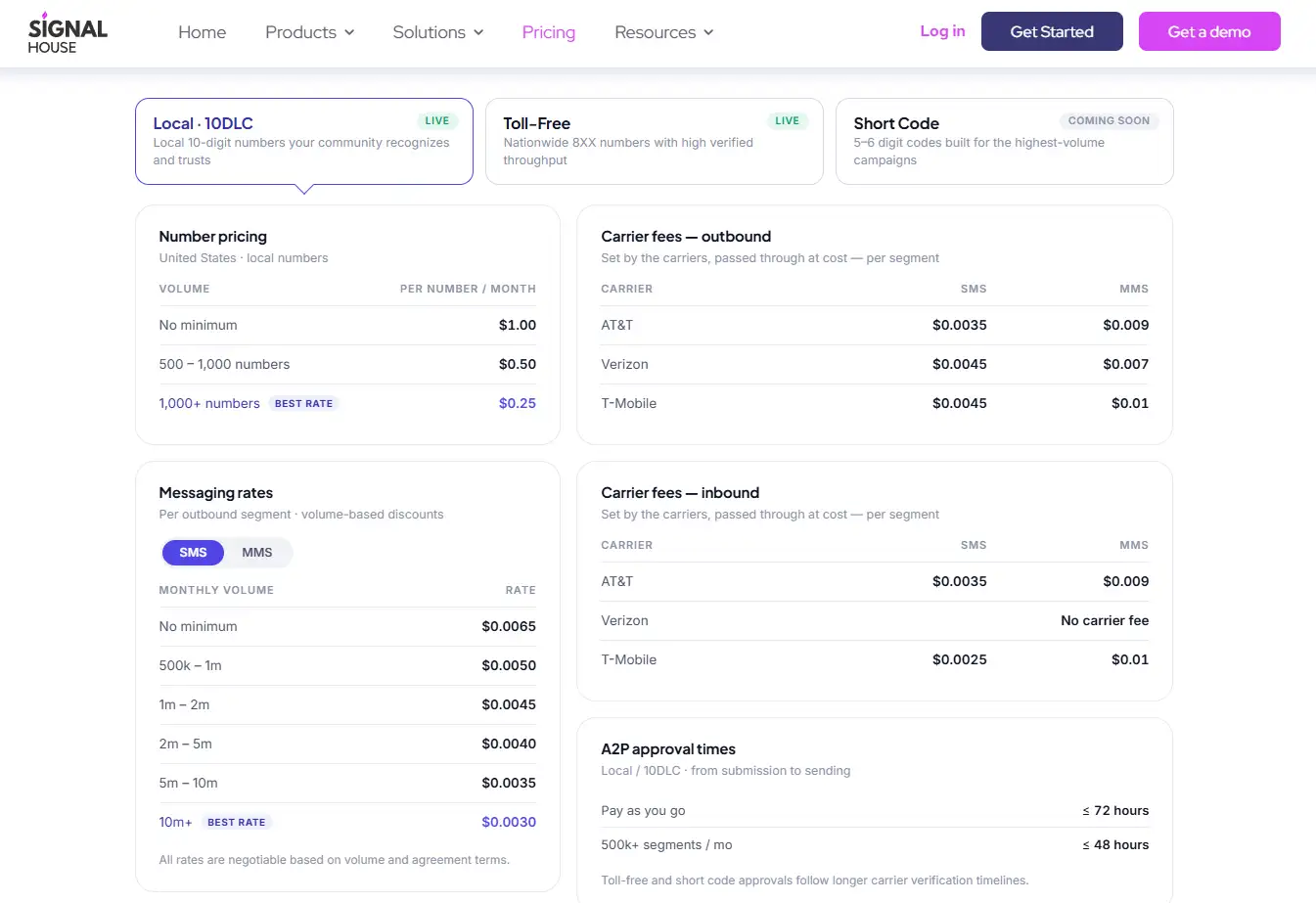
Signal House's current pricing page shows U.S. outbound SMS beginning at $0.0065 per segment and falling to $0.0030 at more than 10 million monthly segments. Twilio currently lists U.S. outbound long-code SMS at $0.0083 per segment before applicable carrier fees.
Lower, Volume-Based SMS Pricing
Pricing is one of the clearest differences between the two platforms.
Signal House publishes volume-based SMS pricing that decreases as monthly messaging volume increases.
The current published rates are:
Monthly volume |
Signal House outbound SMS rate |
|---|---|
No minimum |
$0.0065 |
500k–1M |
$0.0050 |
1M–2M |
$0.0045 |
2M–5M |
$0.0040 |
5M–10M |
$0.0035 |
10M+ |
$0.0030 |
Twilio's standard U.S. SMS pricing currently starts at $0.0083 for outbound messages to U.S. long codes. Carrier fees apply separately, and Twilio also offers volume discounts.
That makes Signal House particularly interesting for companies sending hundreds of thousands or millions of SMS segments every month.
Signal House advertises savings of up to 80% compared with Twilio in some use cases. Actual savings will depend on volume, carrier fees, number types, negotiated rates, and the services a business uses, so companies should compare the total monthly cost rather than only the headline SMS rate.
Faster A2P 10DLC Approval
A2P 10DLC registration is an essential part of sending compliant application-to-person SMS traffic in the United States.
This process can become a bottleneck when a company needs to launch a new messaging campaign quickly.
Signal House makes faster A2P onboarding one of its main selling points. Its current pricing page lists:
Pay as you go: approval in ≤72 hours
500k+ segments per month: approval in ≤48 hours
These timelines apply to local 10DLC campaigns from submission to sending. Toll-free and short-code verification follows different carrier timelines.
For agencies, SaaS platforms, lead-generation companies and high-volume messaging teams, shortening the time between campaign submission and launch can be a meaningful operational advantage.
White-Glove Human Support
Support is another area where Signal House takes a different approach.
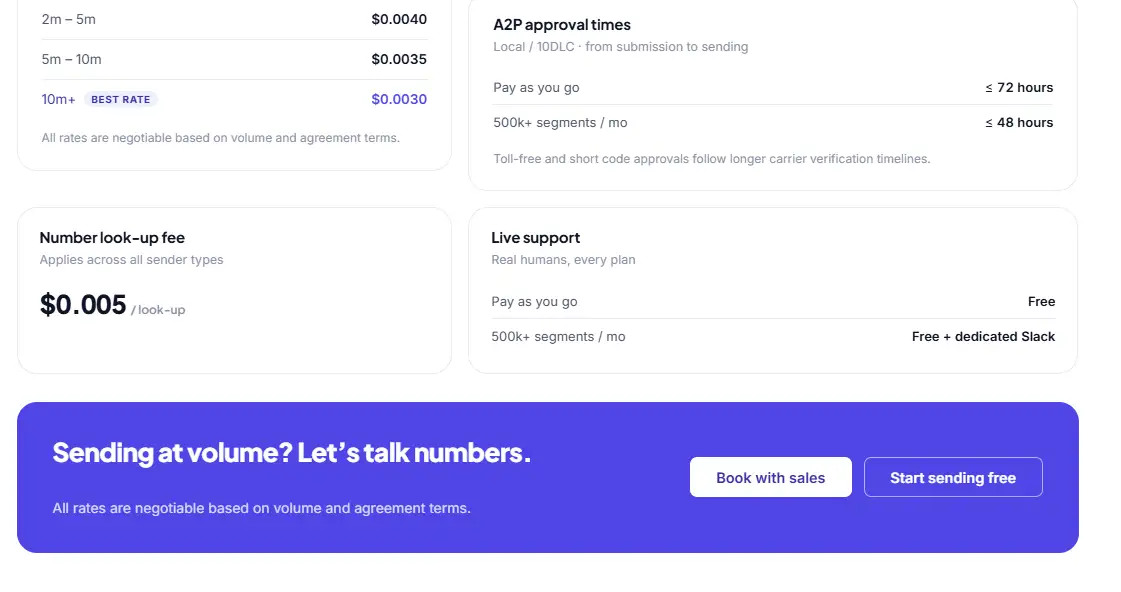
Its pricing page states that live human support is included on every plan. Pay-as-you-go customers receive support at no additional cost, while customers sending more than 500,000 segments per month can also receive a dedicated Slack channel.
Twilio also provides support, but the structure is different.
Its Developer plan is included for free, while plans with guaranteed response times are paid. Twilio's current Production support plan costs the greater of $250 per month or 4% of monthly spend. Business support starts at the greater of $1,500 or 6%, and Personalized support starts at the greater of $5,000 or 8%.
For large enterprises, these structured support plans can make sense. Smaller businesses and teams without dedicated telecom specialists, however, may prefer having human assistance included with the messaging platform.
Simpler Messaging APIs
Twilio's breadth is one of its biggest strengths.
The company supports a wide range of products across messaging, voice, authentication and other communications use cases. That makes it attractive to engineering teams building complex communications infrastructure.
Signal House takes a more focused approach.
Its Messaging APIs emphasize straightforward integration, documentation, SDKs, testing environments, scalability and one-to-one implementation support. The company also offers integrations aimed at connecting messaging with existing CRMs and business workflows.
This narrower approach can be useful for businesses that do not need an entire communications ecosystem and simply want to add messaging to their existing technology stack.
Deliverability and Routing
Pricing matters, but successful message delivery matters more.
Signal House says it operates as a Tier 2 aggregator, meaning messages pass through at most one additional layer before reaching carriers and customer handsets. The company argues that this architecture helps improve speed, visibility and support turnaround.
Signal House also promotes deliverability above 95% on its website. That figure should be treated as a company-reported performance claim rather than a universal guarantee because real-world delivery rates vary by campaign type, sender reputation, carrier filtering, content, opt-in practices and recipient data.
Twilio, meanwhile, operates a much broader global messaging infrastructure and provides features for delivery insights, compliance and opt-out protection.
For businesses evaluating either platform, testing deliverability using their actual traffic profile is more useful than relying solely on headline percentages.
What About Voice?
Both Signal House and Twilio support voice communications.
Signal House supports Voice APIs as well as voice functionality within its applications, allowing businesses to manage calling alongside SMS and MMS within the same platform. This gives teams the flexibility to use voice and messaging together without relying on separate communication tools.
Twilio also provides a mature Programmable Voice platform with extensive customization options and documentation for more complex voice workflows.
For businesses that need messaging together with integrated voice capabilities, both platforms can support these use cases, with the best choice depending on the level of customization and infrastructure required.
When Twilio Is the Better Choice
Twilio can still be the better option when a business needs:
a broad communications API ecosystem;
mature programmable voice functionality;
extensive global communications coverage;
highly customized developer-led infrastructure;
or an existing Twilio implementation where migration costs would outweigh potential savings.
Its size, documentation, ecosystem and range of communications products remain major strengths.
When Signal House Makes More Sense
Signal House is worth considering when SMS is a core part of the business and the company values lower published messaging rates, faster onboarding and direct access to support.
It may be particularly relevant for SaaS companies, marketing platforms, agencies, SMBs and high-volume senders that want to reduce the operational complexity of business messaging.
The platform's combination of volume-based rates, included human support, guided A2P onboarding and developer-friendly messaging APIs creates a different proposition from a large general-purpose CPaaS platform.
Signal House vs. Twilio: The Verdict
Twilio remains one of the strongest choices for companies building sophisticated, multi-channel communications infrastructure.
Signal House is more focused.
Its value proposition centers on the practical problems businesses encounter when operating SMS programs: cost, A2P registration, support, routing, implementation and day-to-day usability.
For companies that mainly use Twilio for SMS, Signal House's published pricing can be notably lower. Higher-volume customers can also receive faster published A2P approval times and a dedicated support channel without purchasing a separate premium support package.
Businesses that rely on Twilio's complete ecosystem may have fewer reasons to migrate. But organizations primarily looking for a simpler and potentially more cost-efficient SMS platform should consider Signal House alongside Twilio and other leading providers.
For a broader comparison, see Signal House's Best Twilio Alternatives in 2026 guide.
FAQ
Yes. Signal House positions itself as a Twilio alternative focused particularly on business SMS and MMS, with lower published SMS pricing, A2P onboarding, integrations and human support.
For standard U.S. outbound SMS, Signal House currently publishes a starting rate of $0.0065 per segment, compared with Twilio's standard published rate of $0.0083 per outbound long-code segment. Signal House's rate falls to $0.0030 at more than 10 million monthly segments. Carrier fees and other costs may apply to both providers.
Yes. Signal House says live human support is included on every plan, with a dedicated Slack channel available for customers sending at least 500,000 segments per month.
Signal House promotes Voice APIs on its homepage, but its current product navigation also lists Voice as an upcoming product. Businesses specifically requiring Voice should verify current production availability directly with Signal House.